The ongoing climate change is driven by the greenhouse effect of such radiative gases as CO2. It however has been a challenge to acquire an accurate long-term radiation record, like the Keeling curve of the CO2 concentration, to irrefutably nail down climate change. Lei’s research found that the over 20-years AERI data measured at the SGP site presents such a highly wanted radiative Keeling curve and discloses interesting climate change signals of both CO2 itself (climate forcing) and mid-latitude clouds (climate feedback).
Author: huanggroup
Protected: Backup your data!
Protected: How to prescribe insolation in RRTM
JAOT paper on water vapor retrieval
Cloud usually is a trouble maker in satellite remote sensing. Jing however worked out an idea that uses the help of clouds to detect water vapor in the upper-troposphere and lower stratosphere (UTLS) region, where the retrieval is known to be especially challenging and water vapor variability at small spatial scales (<100km) had never been successfully retrieved by satellites. This work is accepted for publication in the Journal of Atmospheric and Oceanic Technology. Congratulations to Jing!
JGR paper on PET
GCMs generally project an increase of poleward energy transport (PET) in the atmosphere and decrease of it in the ocean during global warming. In this paper, we argue both of these changes directly result from the spatial pattern of CO2 radiative forcing. To test this idea, we conduct denial experiments with a coupled GCM, in which CO2 forcing is homogenized using a special CO2 prescription scheme. To dissect the radiative forcing and feedback effects on atmospheric and oceanic PETs respectively, we also developed a new set of radiation kernels – we welcome everyone to use these kernels! Another interesting finding of this paper is that we find we can kill Arctic warming amplification by varying the CO2 forcing! Read more in the paper!
Cover letter
As a first time writer, you may have no clue on how to write a cover letter for your paper to submit. Here are some useful tips provided by a Nature Editor: How to write a cover letter. You will also find there a link to How to write a rebuttal letter.
Protected: Archive data!
GCM history
I came across this interesting website about the history of General Circulation Models:
http://pne.people.si.umich.edu/sloan/mainpage.html
While reading it, I recalled a personal account of the early development at Princeton/GFDL by its first director, Joseph Smagorinsky, as (earliest) part of the story:
https://www.dropbox.com/s/u3mv79u2jvz4s80/smargorinsky1983advGeophys_beginning_NWP.pdf?dl=0
CSA proposal funded
Our proposal to study atmospheric water vapor is funded by the Canadian Space Agency. In this project we will use satellite data to study the water budget in the climatically very important UTLS region. A new postdoc is WANTED for this research (see the ad below); prospective graduate students interested in the topic are equally welcome to join this research!
Postdoctoral Fellow Position in Satellite Data Analysis and Atmospheric Modeling
We seek a postdoctoral fellow to analyze satellite data and conduct numerical simulations for understanding atmospheric water vapor distribution and variation in the upper-troposphere and lower-stratosphere region.
Required qualifications include:
PhD in Atmospheric Sciences or a relevant physical science discipline (e.g., Meteorology, Physics, Computational Fluid Dynamics, etc.); and
Experience of scientific computing and capability of running high-resolution atmospheric dynamics models such as WRF and transport model such as HYSPLIT.
Desirable qualifications:
Experience of satellite data analysis; and
Knowledge of radiative transfer and cloud physics.
The initial appointment will be for one year, renewable contingent on satisfactory performance and funding availability. Interested candidates should contact Professor Yi Huang (yi.huang@mcgill.ca) by email, enclosing a curriculum vitae, transcripts of academic records, and names and contacts of at least two references.
Jing won CMOS Award
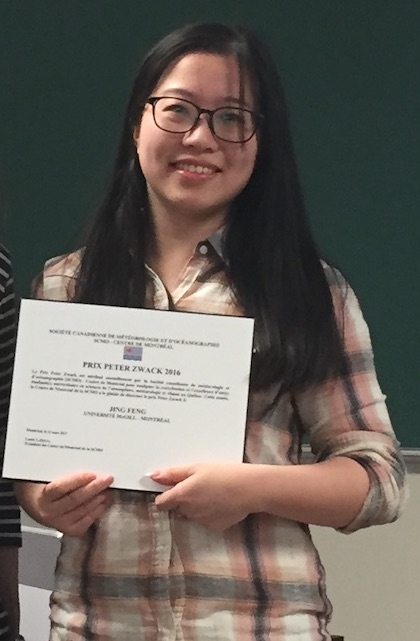
Jing Feng is presented the 2016 CMOS Peter Zwack Award today for her excellent academic performance during her MSc; she has now fast-tracked to PhD. Congratulations to Jing!
 AtmRad @ McGill